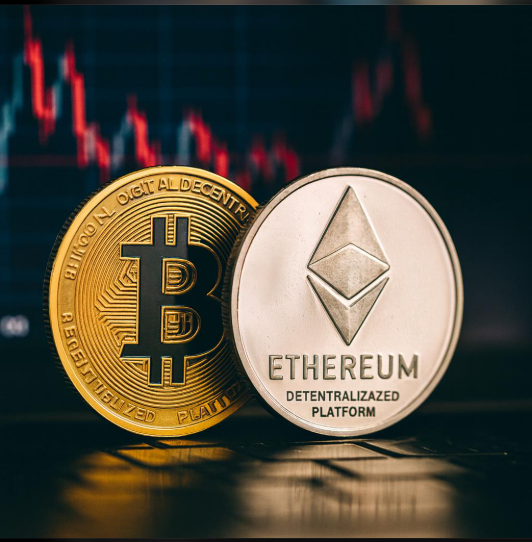
Is It Better to Invest in ETH or BTC? A Complete Guide to Bitcoin vs. Ethereum
Introduction
Cryptocurrency has become an important topic in modern investing, attracting beginners, experienced investors, and businesses interested in digital assets. Among the thousands of cryptocurrencies available, Bitcoin (BTC) and Ethereum (ETH) are two of the best-known options.
Many investors ask the same question: Is it better to invest in ETH or BTC?
The answer depends on your investment goals, risk tolerance, financial situation, and understanding of the cryptocurrency market. Bitcoin is widely viewed as a digital store of value because of its limited supply and established position in the cryptocurrency market. Ethereum, on the other hand, supports a broader blockchain ecosystem that includes decentralized applications, smart contracts, digital assets, and decentralized finance.
Both cryptocurrencies offer potential opportunities, but neither guarantees profits. Their prices can fluctuate significantly, and investors can lose some or all of their money. The US Securities and Exchange Commission has warned investors that Bitcoin and Ether are highly speculative assets that require careful consideration before investing.
In this article, we will compare Bitcoin and Ethereum, examine their advantages and disadvantages, and explain how investors can decide which cryptocurrency may be more suitable for their needs.
1. What Is Bitcoin (BTC)?
Bitcoin is a decentralized digital currency launched in 2009 under the name of its pseudonymous creator, Satoshi Nakamoto.
Unlike traditional currencies issued by central banks, Bitcoin operates through a distributed network of computers. Transactions are recorded on a public blockchain, allowing participants to transfer value without relying on a traditional bank to process every transaction.
One of Bitcoin’s most distinctive characteristics is its maximum supply of 21 million coins. This limit is built into its protocol and is a major reason why some investors compare Bitcoin to digital gold.
Bitcoin is commonly used for:
- Long-term speculative investment.
- Transferring value between individuals.
- Holding a digital asset outside the traditional banking system.
- Gaining exposure to the cryptocurrency market.
- Trading based on changes in market prices.
Some investors purchase Bitcoin because they believe increasing adoption and its limited supply could support its value over time. However, scarcity alone does not guarantee that an asset’s price will rise. Demand, market conditions, regulation, and investor sentiment also matter.
Bitcoin remains a risky investment, and its price can decline sharply during market downturns.
2. What Is Ethereum (ETH)?
Ethereum is a decentralized blockchain platform launched in 2015. It was designed to do more than transfer digital currency between users.
Ethereum allows developers to create applications using smart contracts. Smart contracts are programs that execute specific actions when predetermined conditions are met.
The cryptocurrency associated with the Ethereum network is called Ether, commonly represented by the ticker symbol ETH.
ETH has several important uses within the Ethereum ecosystem, including:
- Paying transaction fees on the network.
- Supporting decentralized applications.
- Participating in Ethereum’s proof-of-stake validation system.
- Interacting with decentralized finance platforms.
- Transferring value between users.
- Serving as a speculative investment.
Ethereum supports applications involving lending, borrowing, digital collectibles, token creation, and decentralized exchanges.
Its broader functionality attracts investors who believe blockchain-based applications could become increasingly useful in the future.
However, Ethereum also faces risks related to competition, technology, regulation, network activity, and the changing demand for ETH.
Unlike Bitcoin, Ether does not have a fixed maximum supply of 21 million coins. Its supply changes through issuance and the burning of transaction fees, so its long-term supply depends partly on network activity and staking conditions.
3. Bitcoin vs. Ethereum: What Are the Main Differences?
Bitcoin and Ethereum both use blockchain technology, but their purposes and technical designs differ.
| Feature | Bitcoin (BTC) | Ethereum (ETH) |
|---|---|---|
| Main purpose | Decentralized digital currency and potential store of value | Blockchain platform for smart contracts and decentralized applications |
| Launch year | 2009 | 2015 |
| Maximum supply | 21 million BTC | No fixed maximum supply |
| Consensus mechanism | Proof of work | Proof of stake |
| Smart contracts | Limited scripting capabilities | Supports programmable smart contracts |
| Network uses | Payments and digital-asset transfers | Applications, decentralized finance, tokens, and transfers |
| Network security | Relies on proof-of-work mining | Relies on proof-of-stake validators |
| Main investment argument | Scarcity, recognition, and adoption | Network utility, ecosystem growth, and demand for ETH |
| Major risks | Price volatility, regulation, custody, and market demand | Price volatility, technical complexity, competition, regulation, and market demand |
These differences matter because investors are not simply choosing between two similar coins. They are choosing between digital assets with different economic characteristics and potential sources of demand.
Neither asset is automatically better in every market condition.
4. Advantages of Investing in Bitcoin
A. Limited Supply
Bitcoin’s maximum supply of 21 million coins is one of its most widely discussed features.
Supporters believe that limited supply could make Bitcoin attractive to people seeking an asset with a predetermined issuance schedule.
However, a limited supply does not guarantee price appreciation. Bitcoin’s value still depends on whether buyers are willing to purchase and hold it at a particular price.
B. Strong Brand Recognition
Bitcoin is one of the most recognizable cryptocurrencies in the world.
Its long operating history and broad recognition may make it easier for new investors to research compared with many smaller digital assets.
Bitcoin is also commonly used as a starting point for people learning about cryptocurrency.
C. A Relatively Simple Investment Thesis
Bitcoin’s primary investment narrative is easier to explain than Ethereum’s broader technological ecosystem.
Investors may purchase BTC because they believe it could become a more widely adopted store of value or digital monetary asset.
This does not make Bitcoin a simple or safe investment, but it gives investors a relatively clear central idea to evaluate.
D. Established Market Presence
Bitcoin has a long trading history and substantial global recognition.
This may make it easier for investors to find market information, research reports, and trading services than it is for less-established cryptocurrencies.
Nevertheless, market access does not eliminate the risks of fraud, platform failure, or price volatility.
Disadvantages of Bitcoin
Bitcoin also has disadvantages:
- Its price can experience severe declines.
- It does not generate business profits like a conventional company.
- Its investment value depends heavily on market demand.
- Proof-of-work mining consumes substantial energy.
- It faces regulatory and technological uncertainties.
- Investors may lose access to their holdings through theft or lost credentials.
Bitcoin should therefore not be considered a guaranteed way to protect wealth or earn profits.
5. Advantages of Investing in Ethereum
A. A Broad Range of Applications
Ethereum supports smart contracts and decentralized applications.
These technologies allow developers to create systems for lending, borrowing, trading, digital ownership, and other blockchain-based activities.
Investors who believe these applications will attract greater usage may see ETH as a way to gain exposure to the development of the Ethereum ecosystem.
However, increased application usage does not automatically mean ETH’s market price will increase. The relationship depends on network economics, competition, demand, and other factors.
B. Staking Opportunities
Ethereum uses proof of stake to secure its network.
Eligible participants can stake ETH directly or through certain services to participate in network validation and potentially receive rewards.
Staking is not the same as receiving guaranteed bank interest. Rewards can vary, and participants may face technical risks, service-provider risks, penalties, lock-up conditions, and changes in the value of ETH.
For example, an investor might earn staking rewards while the market price of ETH falls enough to produce an overall investment loss.
Investors should understand the arrangements and risks before staking their assets.
C. A Programmable Blockchain
Ethereum’s ability to support smart contracts makes it useful for a broad range of blockchain applications.
Its ecosystem includes decentralized exchanges, lending protocols, stablecoins, and tokenized assets.
If demand for Ethereum-based services grows, it could create additional demand for ETH through transaction fees, staking, and other network activities.
However, Ethereum competes with other blockchain platforms, and its future success is not guaranteed.
D. A Different Investment Opportunity
Ethereum provides exposure to a different part of the cryptocurrency industry.
While Bitcoin is often discussed as a digital store of value, Ethereum is also valued for its role as programmable blockchain infrastructure.
Investors who believe decentralized applications will become more widely used may find Ethereum’s technology particularly interesting.
Disadvantages of Ethereum
Ethereum also comes with significant risks:
- ETH can experience substantial price declines.
- Its value depends partly on the demand for the Ethereum ecosystem.
- Other blockchain platforms compete for developers and users.
- Smart contracts and decentralized applications can contain vulnerabilities.
- Transaction fees and network conditions can change.
- Staking arrangements can introduce additional risks.
- Regulatory changes may affect parts of the ecosystem.
Ethereum’s wider range of applications may create opportunities, but it also introduces additional technical and competitive considerations.
6. Which Cryptocurrency Has the Better Long-Term Potential?
There is no reliable way to know with certainty whether Bitcoin or Ethereum will deliver higher returns over the next five or ten years.
Their long-term performance will depend on adoption, market demand, technological development, regulation, investor confidence, and broader economic conditions.
Bitcoin’s Long-Term Potential
Bitcoin’s investment case often focuses on its limited supply, recognition, decentralization, and possible role as a digital store of value.
If more individuals, institutions, or businesses decide to hold Bitcoin, demand could increase.
However, this outcome is not guaranteed. Bitcoin could also experience prolonged periods of weak demand, falling prices, or changes in investor preferences.
Ethereum’s Long-Term Potential
Ethereum’s investment case focuses partly on the adoption of smart contracts, decentralized finance, tokenized assets, and other blockchain applications.
If Ethereum continues to attract developers and users, demand for its network services could support the role of ETH within the ecosystem.
However, the network faces competition, technical challenges, and uncertainty about how much economic value will ultimately accrue to ETH holders.
Which Is Better for Long-Term Investing?
Bitcoin may be more appealing to investors who primarily want exposure to a scarce digital asset.
Ethereum may be more appealing to investors who want exposure to programmable blockchain technology and believe decentralized applications will expand.
Both are speculative investments. Neither has a guaranteed long-term return, and historical performance should not be treated as a reliable prediction of future results.
7. Which Cryptocurrency Is Better for Beginners?
For beginners, Bitcoin may be easier to understand because its central investment narrative focuses on digital currency and scarcity.
Ethereum may require additional learning because its ecosystem includes smart contracts, decentralized applications, staking, and other technical concepts.
However, ease of understanding does not necessarily mean lower investment risk.
A beginner who understands Bitcoin can still lose money if they purchase it at an inflated price. Similarly, someone who understands Ethereum’s technology can still experience losses when ETH prices decline.
Before buying either cryptocurrency, beginners should:
- Learn the basic principles of cryptocurrency.
- Understand the risks of price volatility.
- Research how wallets and exchanges work.
- Protect their accounts and recovery information.
- Avoid borrowing money to invest.
- Never invest money needed for essential expenses.
- Compare fees and withdrawal conditions.
- Decide how much they can afford to lose.
A beginner should focus on understanding the investment rather than chasing whichever coin is receiving the most attention online.
8. Can You Invest in Both BTC and ETH?
Yes. An investor can hold both Bitcoin and Ethereum rather than choosing only one.
Holding both may provide exposure to two different cryptocurrency investment ideas: Bitcoin’s potential role as a store of value and Ethereum’s role in programmable blockchain applications.
However, owning both does not eliminate cryptocurrency risk.
Bitcoin and Ethereum can decline at the same time because both may be affected by changing investor sentiment, regulatory developments, liquidity conditions, and broader market movements.
For example, an investor might divide a cryptocurrency allocation between BTC and ETH. If the overall cryptocurrency market experiences a major downturn, both holdings could lose value.
The appropriate allocation depends on the investor’s financial situation, risk tolerance, and investment objectives. There is no universally correct percentage for everyone.
Investors should also remember that cryptocurrency is only one possible part of a broader financial plan. Savings, emergency funds, and diversified traditional investments may be more appropriate priorities for some people.
9. Example: Investing ₦100,000 in BTC or ETH
Suppose an investor has ₦100,000 available for a hypothetical cryptocurrency investment.
The investor is considering three approaches:
- Investing all ₦100,000 in Bitcoin.
- Investing all ₦100,000 in Ethereum.
- Dividing the ₦100,000 between Bitcoin and Ethereum.
The following examples illustrate how gains and losses work. They are not forecasts of future cryptocurrency performance.
Scenario A: The Investment Falls by 30%
If the investor puts ₦100,000 into Bitcoin and its value falls by 30%, the holding becomes worth ₦70,000 before fees.
If the investor instead puts ₦100,000 into Ethereum and its value also falls by 30%, the holding becomes worth ₦70,000 before fees.
If the investor divides the money equally between BTC and ETH, and both decline by 30%, the combined investment also becomes worth ₦70,000 before fees.
Scenario B: Bitcoin Rises by 20% and Ethereum Rises by 10%
If ₦100,000 is invested in Bitcoin and BTC rises by 20%, the investment becomes worth ₦120,000 before fees.
If ₦100,000 is invested in Ethereum and ETH rises by 10%, the investment becomes worth ₦110,000 before fees.
If ₦50,000 is invested in each and those price changes occur, the combined investment becomes worth ₦115,000 before fees.
These examples show that the outcome depends on actual price movements, not simply on which cryptocurrency is more popular.
They also demonstrate why investors should avoid assuming that one asset will always outperform the other.
10. What Risks Should You Consider Before Investing?
Before purchasing BTC or ETH, understand the following risks.
Market Volatility
Both cryptocurrencies can lose a substantial percentage of their value over a short period.
Security Risks
Hackers, phishing attacks, fraudulent platforms, and compromised wallets can result in financial losses.
Regulatory Risks
Government policies and regulations can affect access to cryptocurrency services and market demand.
Liquidity Risks
Some trading platforms or cryptocurrency markets may have limited liquidity, especially during periods of market stress.
Emotional Decisions
Fear of missing out, panic selling, and excessive trading can cause investors to make poor decisions.
Technology Risks
Ethereum’s smart contracts and applications may contain vulnerabilities. Bitcoin also faces technological, network, and operational risks.
Custody Risks
Investors who lose their private keys or recovery phrases may lose access to their assets. People who leave assets with third-party platforms also face the risk that those platforms could fail or restrict withdrawals.
The US Securities and Exchange Commission provides further information about the risks associated with Bitcoin and Ether investments.
11. How to Choose Between BTC and ETH
The right decision begins with your investment goals.
Choose Bitcoin If:
- You are primarily interested in a scarce digital asset.
- You prefer a relatively straightforward cryptocurrency investment thesis.
- You want exposure to Bitcoin’s established market presence.
- You understand that its price can still decline significantly.
Consider Ethereum If:
- You are interested in blockchain applications and smart contracts.
- You want exposure to Ethereum’s decentralized application ecosystem.
- You understand the additional risks associated with its technology and applications.
- You have researched staking and other Ethereum-related services before using them.
Consider Both If:
- You want exposure to different cryptocurrency investment ideas.
- You understand that both assets can decline together.
- Your financial circumstances allow you to take speculative investment risk.
- You have an investment plan that does not depend on guaranteed cryptocurrency profits.
These are general considerations, not personalized investment recommendations. Your financial goals, existing savings, debts, and ability to tolerate losses should guide your decision.
12. Common Mistakes to Avoid When Investing in BTC or ETH
Many investors experience unnecessary losses because they approach cryptocurrency without a clear strategy.
Avoid these common mistakes:
Buying because of social media hype: Popularity does not guarantee future price increases.
Expecting guaranteed profits: No one can reliably guarantee that BTC or ETH will increase in value.
Investing emergency savings: Money needed for essential expenses should not be exposed to substantial speculative risk.
Borrowing to invest: Debt can make cryptocurrency losses more damaging.
Ignoring transaction fees: Trading, network, withdrawal, and conversion fees can reduce returns.
Neglecting security: Poor account security can expose funds to theft.
Assuming a lower coin price means a better investment: The price of one ETH being lower than the price of one BTC does not mean ETH is cheaper in investment terms. Market capitalization, supply, demand, and future expectations matter more than the price of a single coin.
Believing past performance guarantees future returns: Neither Bitcoin nor Ethereum is guaranteed to repeat its historical gains.
Frequently Asked Questions (FAQs)
1. Is BTC better than ETH?
Bitcoin may suit investors who are interested in a scarce digital asset and its potential role as a store of value. Ethereum may suit investors who are interested in smart contracts and blockchain applications. Neither is universally better, and both involve substantial risk.
2. Is ETH a good investment in 2026?
Ethereum may interest investors who believe its ecosystem will continue to develop, but its future performance is uncertain. Before investing in 2026, consider current market conditions, network adoption, competition, fees, regulation, and your ability to tolerate losses.
3. Will Ethereum overtake Bitcoin?
It is impossible to know. Ethereum and Bitcoin have different purposes and investment narratives. Ethereum could grow in adoption without overtaking Bitcoin in market capitalization, and neither outcome is guaranteed.
4. Which is safer, Bitcoin or Ethereum?
Neither is a safe investment in the sense of a guaranteed return or protection from losses. Bitcoin and Ethereum both experience significant price volatility and face security, regulatory, and market risks.
5. Can I invest a small amount in Bitcoin or Ethereum?
Many cryptocurrency services allow people to purchase fractions of a coin. You do not need to purchase one whole BTC or ETH. However, check minimum purchase requirements, transaction fees, withdrawal costs, and the platform’s terms before investing.
6. Should I buy BTC or ETH for five years?
A five-year holding period does not guarantee a profit. Bitcoin may appeal to investors who believe in its scarcity and store-of-value narrative, while Ethereum may appeal to those who believe in its application ecosystem. Your decision should depend on your research, financial circumstances, and risk tolerance.
7. Is it better to buy Bitcoin when the price falls?
A price decline does not automatically mean Bitcoin is undervalued or that it will recover. Investors should consider their investment plan, market conditions, and risk tolerance rather than assuming that every decline is a buying opportunity.
8. Can I lose all my money in BTC or ETH?
Yes. Although Bitcoin and Ethereum are established cryptocurrencies, investors can still lose all or a substantial portion of their investment under adverse circumstances. They should never invest money they cannot afford to lose.
Conclusion: Is It Better to Invest in ETH or BTC?
Bitcoin and Ethereum are two important cryptocurrencies, but they offer different investment opportunities.
Bitcoin is primarily known for its limited supply, broad recognition, and potential role as a digital store of value. Ethereum is known for its programmable blockchain, smart contracts, decentralized applications, and wider technological ecosystem.
For investors who prefer a simpler digital-asset investment thesis, Bitcoin may be the easier starting point to understand. For investors interested in blockchain applications and decentralized technology, Ethereum may be more appealing. This is a comparison of their characteristics, not a prediction that either will deliver better returns.
Some investors choose to hold both, but doing so does not remove the possibility of substantial losses.
The most important principle is to research before investing, protect your assets, avoid borrowing money, and never assume that cryptocurrency profits are guaranteed. A good investment decision should be based on your financial goals and ability to handle risk—not hype, fear, or promises of quick wealth.
Financial Disclaimer: This article is for educational and informational purposes only. It is not financial or investment advice. Bitcoin and Ethereum are highly speculative assets, and their prices can fluctuate significantly. You may lose some or all of your investment. Conduct independent research and consult a qualified financial professional if necessary before making investment decisions.