How Interest Rates Affect Stock Market Investments: A Complete Guide
Introduction
Interest rates are one of the most important factors influencing the stock market. They affect how much businesses pay to borrow money, how much consumers spend, how investors value companies, and how attractive stocks are compared with other investments.
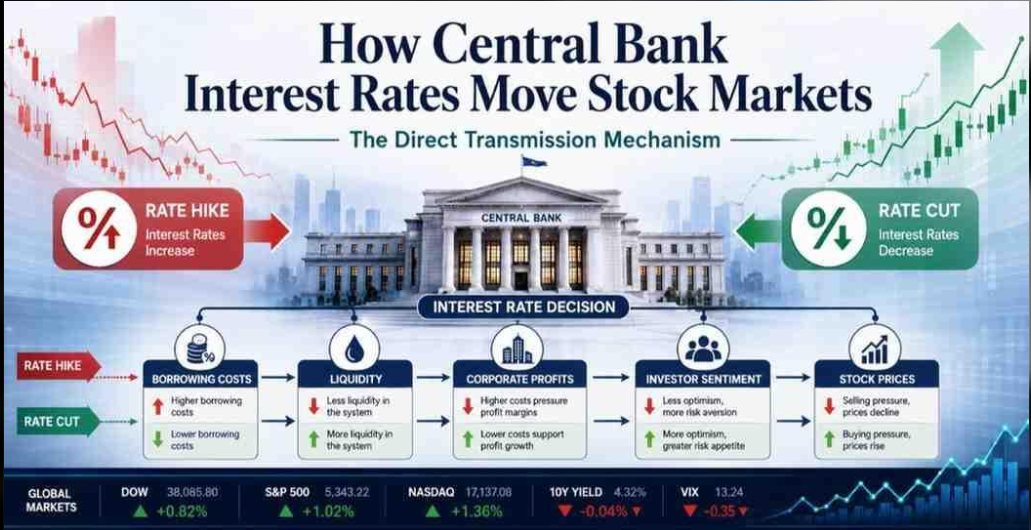
When central banks increase interest rates, stock prices may come under pressure because borrowing becomes more expensive and investors may become more cautious. When interest rates decrease, stock prices may benefit from lower borrowing costs, stronger consumer spending, and improved business investment.
However, the relationship between interest rates and the stock market is not always straightforward. Some companies perform well when interest rates rise, while others struggle. Similarly, falling interest rates do not automatically guarantee that stock prices will increase.
Understanding this relationship can help investors make more informed decisions, manage risk, and develop long-term investment strategies.
In this article, we will explain what interest rates are, how they affect stock market investments, which sectors may benefit from rising or falling rates, and how investors can respond to changing economic conditions.
1. What Are Interest Rates?
Interest rates represent the cost of borrowing money or the return earned from lending or depositing money. They are usually expressed as a percentage.
For example, if a bank lends someone $10,000 at an annual interest rate of 5%, the borrower will generally owe interest on the outstanding balance according to the loan agreement.
Interest rates influence individuals, businesses, financial institutions, and governments.
Central banks, such as the US Federal Reserve and the Bank of England, use monetary policy to influence financial conditions and economic activity. Their decisions can affect short-term borrowing costs and influence other interest rates throughout the economy.
Commercial banks also set their own lending and deposit rates based on factors such as central bank policy, market conditions, credit risk, and funding costs.
When interest rates rise, loans, mortgages, and business financing can become more expensive. When rates fall, borrowing may become more affordable.
These changes can affect corporate profits, consumer spending, investment decisions, and ultimately stock market performance.
2. Why Do Central Banks Change Interest Rates?
Central banks adjust interest rates to help achieve economic objectives, which often include maintaining price stability and supporting sustainable economic activity.
Controlling inflation
Inflation occurs when the general price level of goods and services increases over time, reducing the purchasing power of money.
When inflation remains too high, a central bank may raise interest rates to make borrowing more expensive and encourage saving. This can reduce spending and investment, helping to ease demand pressures.
However, monetary policy usually affects the economy with a delay, and inflation can also be influenced by supply disruptions, energy prices, and other factors.
Supporting economic growth
When economic activity weakens, a central bank may reduce interest rates to make borrowing cheaper and encourage spending and investment.
Lower rates can help businesses finance expansion and make certain purchases more affordable for consumers.
Maintaining financial stability
Central banks also consider how financial conditions affect banks, credit markets, and the broader economy. Their decisions must balance different risks rather than focus on stock prices alone.
For stock investors, understanding why interest rates are changing can be just as important as knowing whether they are rising or falling.
3. How Rising Interest Rates Affect Stock Prices
When interest rates rise, stock prices may face downward pressure through several channels.
Higher borrowing costs for companies
Many businesses borrow money to purchase equipment, expand operations, develop products, or finance acquisitions.
When interest rates increase, companies with variable-rate debt may face higher interest expenses. Businesses that need to refinance existing debt may also have to pay more.
Higher borrowing costs can reduce profits and leave less money available for expansion, dividends, or share repurchases.
For example, imagine a company that pays $5 million annually in interest expenses. If its borrowing costs rise significantly when debt is refinanced, its interest bill could increase and reduce its earnings.
Investors may respond by lowering their estimates of the company’s future profitability, which can put pressure on its share price.
Companies with strong cash reserves and manageable debt may be less affected than heavily indebted businesses.
Lower consumer spending
Higher interest rates can increase the cost of mortgages, credit cards, car loans, and other forms of borrowing.
Households may respond by reducing discretionary spending or postponing large purchases.
This can affect companies that depend on consumer demand, including retailers, car manufacturers, restaurants, travel businesses, and home improvement companies.
If sales weaken, companies may experience slower revenue growth and lower profits.
More attractive alternatives to stocks
When interest rates rise, savings accounts, money-market instruments, and government bonds may offer more attractive yields, depending on their terms and market prices.
Some investors may shift part of their money away from stocks toward these alternatives.
This can reduce demand for shares and place downward pressure on stock prices, particularly when investors believe they can earn reasonable returns with less risk.
However, the relative attractiveness of stocks and bonds depends on more than interest rates. Investors also consider inflation, credit risk, valuation, and potential future earnings.
Lower valuations for some companies
Investors estimate the value of a company by considering the cash it may generate in the future.
When market interest rates rise, the rate used to discount those expected future cash flows may also rise. This can reduce the present value of future earnings and cash flows.
Companies whose valuations depend heavily on profits expected far into the future may be especially sensitive to this change.
As a result, higher interest rates can affect stock valuations even before a company reports a decline in earnings.
4. How Falling Interest Rates Affect Stock Market Investments
Falling interest rates can support stock prices, although the outcome depends on the economic circumstances.
Lower borrowing costs
When financing becomes cheaper, businesses may find it easier to fund new projects, purchase equipment, hire employees, or expand into new markets.
Lower interest expenses can also improve profits for companies that borrow money, provided other business conditions remain favorable.
Increased consumer spending
Lower borrowing costs may make mortgages, car loans, and other forms of credit more affordable.
Households may have more flexibility to spend, while businesses may increase investment.
This can support sales and earnings in certain industries.
Higher valuations
When discount rates fall, the present value of future cash flows may increase, assuming other factors remain unchanged.
This can support valuations, especially for companies expected to generate a large share of their profits in the future.
Reduced appeal of some savings and fixed-income products
If newly available deposits and bonds offer lower yields, investors may become more interested in stocks in search of higher potential returns.
However, stocks carry market risk and can lose value. Investors should not assume that lower deposit rates automatically make stocks attractive.
Why falling rates do not always lift stocks
The reason interest rates are falling matters.
If central banks cut rates because inflation is easing while economic growth remains healthy, stocks may benefit from lower borrowing costs and resilient earnings.
If rates are cut because the economy is entering a severe recession, investors may worry about falling sales, rising unemployment, and declining corporate profits.
In that situation, stock prices can fall despite lower interest rates.
The key lesson is that interest-rate decisions must be interpreted alongside economic growth, inflation, and company earnings.
5. The Relationship Between Interest Rates and Stock Valuations
Interest rates affect the way investors value businesses.
One method used in financial analysis is discounted cash flow valuation. It estimates a company’s value by calculating the present value of its expected future cash flows.
Future money is generally worth less than money received today because investors could otherwise earn a return on their capital and because future cash flows are uncertain.
When the discount rate increases, the present value of a given stream of future cash flows decreases. When the discount rate falls, the present value increases.
This relationship helps explain why interest-rate changes can influence stock prices even when a company’s current earnings remain unchanged.
For example, imagine an investor is evaluating a company expected to generate substantial cash flow over the next ten years.
If interest rates and the required return on the investment increase, the investor may be willing to pay less for those future cash flows today.
However, a company’s required return depends on several factors, including its business risk, financial structure, and the broader market environment. Changes in interest rates do not affect every company equally.
6. Which Stock Market Sectors Are Most Affected by Interest Rates?
Different industries respond to interest-rate changes in different ways.
Technology companies
Technology companies can be sensitive to interest rates, particularly when investors value them based on expected growth far into the future.
Higher rates may reduce the present value of future earnings and make financing more expensive for businesses that depend on borrowing or external investment.
However, profitable technology companies with strong cash flows and limited debt may be more resilient.
Banking and financial services
Banks may benefit from higher rates if they can earn more interest on loans and other assets than they pay on deposits and funding.
However, rising rates can also increase funding costs, reduce loan demand, weaken borrowers’ ability to repay debt, and reduce the market value of certain existing bonds.
The overall effect depends on each bank’s balance sheet, funding structure, loan portfolio, and competitive environment.
Real estate
Real estate companies and real estate investment trusts (REITs) can be sensitive to interest rates because property purchases often rely on borrowing.
Higher rates may increase financing costs and reduce property affordability. They can also make income-producing real estate less attractive relative to certain bonds.
Falling rates may improve financing conditions, but real estate businesses can still struggle if demand weakens or property values decline.
Consumer discretionary companies
Businesses selling non-essential goods and services may be affected when higher borrowing costs reduce household spending.
Companies selling cars, luxury products, travel services, and home furnishings may experience weaker demand if consumers become more cautious.
Utilities
Utilities often operate capital-intensive businesses that require significant investment in infrastructure.
Higher interest rates can increase their financing costs. Because some utility stocks are purchased for their dividend income, rising bond yields may also make them less attractive to some investors.
However, regulated revenue models and relatively stable demand can provide support in certain markets.
Consumer staples
Companies selling essential products, such as basic food and household goods, may experience more stable demand than businesses selling discretionary products.
Nevertheless, consumer staples stocks are not immune to higher interest rates. Their valuations, debt costs, input prices, and customer behavior can still be affected.
No sector is guaranteed to benefit from a particular interest-rate environment. Company-specific financial strength and valuation remain important.
7. Growth Stocks Versus Value Stocks When Interest Rates Change
Growth stocks and value stocks can respond differently to changes in interest rates.
Growth stocks are often valued partly on the expectation of earnings and cash flows far into the future. Higher discount rates can reduce the present value of those expected future cash flows.
For this reason, expensive growth stocks can be particularly sensitive to rising interest rates.
Value stocks are often associated with lower valuations relative to measures such as earnings, cash flow, or assets. Some value companies also generate more cash in the present rather than relying heavily on distant future growth.
These characteristics can sometimes make certain value stocks less sensitive to changes in discount rates.
However, there is no universal rule that value stocks outperform growth stocks when rates rise, or that growth stocks always outperform when rates fall.
The result depends on the starting valuations, the companies’ financial conditions, the economic outlook, and what investors already expect.
A value stock with excessive debt may be vulnerable to higher interest costs, while a profitable growth company with strong cash flow may remain resilient.
8. Interest Rates and Dividend Stocks
Interest rates are especially relevant to investors who hold dividend-paying stocks.
When interest rates rise, government bonds and other interest-bearing investments may offer higher yields. Some investors may become less willing to pay high prices for dividend stocks when they can earn more income from alternatives with different risk characteristics.
This can place downward pressure on the prices of certain dividend-paying shares.
Higher interest rates can also affect dividend companies through borrowing costs. Businesses with heavy debt may have less cash available to support dividend payments.
However, a rising interest-rate environment does not automatically make dividend stocks unattractive.
Companies with strong balance sheets, sustainable cash flow, and the ability to increase earnings may continue to pay and potentially grow their dividends.
When rates fall, dividend stocks may become more appealing to investors seeking income. But a high dividend yield should never be the only reason to purchase a stock.
Investors should examine the company’s payout ratio, free cash flow, debt, and ability to maintain distributions during difficult periods.
9. How Interest Rates Affect Bond Investments Compared With Stocks
Interest rates affect bonds and stocks in different ways.
Existing fixed-rate bonds generally decline in market price when comparable market interest rates rise. This occurs because newly issued bonds may offer higher yields, making older bonds with lower coupon payments less attractive.
When market rates fall, existing fixed-rate bonds may increase in price because their coupon payments become more competitive.
Stocks do not have the same fixed-payment structure. Their values depend on future earnings, cash flows, dividends, and investor expectations.
Higher interest rates can pressure stock valuations, but strong corporate earnings may offset some of that pressure. Likewise, lower rates can support valuations, but falling profits may still cause stocks to decline.
For investors, comparing stocks and bonds involves evaluating expected returns, risk, time horizon, income requirements, and diversification.
A portfolio containing different asset classes may help manage risk, although diversification does not guarantee profits or prevent losses.
10. How Investors Can Respond to Changing Interest Rates
Investors cannot control central bank decisions, but they can develop strategies to manage changing market conditions.
Focus on long-term business fundamentals
Avoid basing every investment decision on a single interest-rate announcement.
Examine companies’ revenue, profits, cash flow, debt, and competitive advantages. Strong businesses may adapt to changing economic conditions better than financially weak competitors.
Review company debt
Companies with large variable-rate loans or substantial refinancing needs may be more vulnerable when rates rise.
Check debt maturity dates, interest expenses, and the company’s ability to generate enough cash to meet its obligations.
Avoid paying excessive valuations
Interest-rate changes can alter the prices investors are willing to pay for future growth.
Buying a company at a reasonable valuation can reduce the risk of relying on overly optimistic expectations.
Diversify your investments
Consider spreading investments across different companies, sectors, and asset classes instead of depending on one industry.
Diversification can reduce exposure to particular risks, but it cannot eliminate market-wide declines.
Maintain an appropriate time horizon
Short-term interest-rate movements can cause volatility. Investors with long-term goals may be better served by a disciplined investment plan than by repeatedly attempting to predict market movements.
However, money needed for near-term expenses should generally not be exposed to stock-market risk without careful consideration.
Keep an emergency fund
Having accessible savings for unexpected expenses can reduce the pressure to sell investments during a market decline.
Review, rather than constantly trade
Investors should periodically review their portfolios to ensure that their holdings still fit their objectives and risk tolerance.
Frequent trading based on interest-rate predictions can increase costs and lead to poor decisions.
11. Common Mistakes Investors Make About Interest Rates
Assuming higher rates always cause stocks to fall
Higher rates can pressure valuations and borrowing costs, but stock prices also respond to earnings growth, economic strength, inflation expectations, and market sentiment.
If interest rates rise because the economy is performing strongly, some companies may continue to grow profits.
Assuming rate cuts always make stocks rise
Central banks sometimes cut rates in response to severe economic weakness. If investors expect falling corporate profits, stock prices may decline despite lower borrowing costs.
Ignoring what markets already expect
Stock prices often react to the difference between an announcement and what investors expected beforehand.
A rate increase that has been widely anticipated may have a smaller effect than an unexpected decision or a change in the central bank’s future outlook.
Focusing only on the policy rate
Long-term government bond yields, inflation expectations, credit spreads, and lending conditions can also influence investment valuations.
The central bank’s policy rate is important, but it is not the only interest rate that matters.
Making emotional decisions
Selling investments in panic after a rate announcement or buying stocks simply because rates have been cut can lead to poor results.
A well-considered strategy should account for both opportunities and risks.
12. A Practical Example of Interest Rates Affecting an Investor
Imagine an investor owns shares in two companies.
The first company is a rapidly growing technology business with a high valuation and substantial borrowing needs. The second is an established consumer goods company with steady cash flow and relatively low debt.
If interest rates rise, the technology company could face higher financing costs, while its expected future earnings may be valued less generously by investors.
The consumer goods company may be less affected by financing costs because it has limited debt. However, if higher interest rates reduce consumer spending, it could still experience weaker sales.
Now imagine that interest rates fall.
The technology company’s financing costs may decline, and investors may become more willing to pay for future growth. The consumer goods company may also benefit if lower borrowing costs support consumer demand.
But if rates fall because the economy enters a recession, both companies could experience weaker sales or profits.
This example shows why investors should examine interest rates alongside company fundamentals and the broader economic outlook rather than assuming every stock will react in the same way.
Conclusion
Interest rates play a major role in stock market investments because they influence borrowing costs, consumer spending, corporate profits, stock valuations, and the relative attractiveness of different asset classes.
Rising interest rates can put pressure on stock prices by increasing financing costs, reducing some forms of spending, and lowering the present value of future cash fl