What Is Growth Investing and Value Investing? A Complete Guide for Beginners
Introduction
Investing in the stock market offers different ways to build wealth, and two of the most popular strategies are growth investing and value investing. Both approaches aim to help investors earn returns over time, but they focus on different characteristics when selecting stocks.
Growth investing focuses on companies that are expected to increase their revenue, earnings, and market value faster than average. Value investing, on the other hand, focuses on finding stocks that appear to be trading below their underlying business value.
Understanding the difference between growth investing and value investing can help beginners make more informed investment decisions. Each strategy has advantages, disadvantages, and risks, and neither guarantees profits.
In this guide, we will explain how growth investing and value investing work, their main differences, how investors evaluate stocks, and how to decide which approach may suit their financial goals.
What Is Growth Investing?
Growth investing is an investment strategy that focuses on companies expected to grow their revenue, profits, or cash flow faster than the broader market or their industry.
Growth investors generally believe that companies with strong expansion opportunities can become significantly more valuable over time. As the businesses grow, their stock prices may increase, potentially generating capital gains for shareholders.
Growth companies are often found in industries such as technology, healthcare, e-commerce, renewable energy, and digital services. However, growth investing is not limited to these sectors.
A growth company might be developing innovative products, entering new markets, attracting more customers, or benefiting from a major change in consumer behavior.
How Growth Investing Works
Growth investors study a company’s future opportunities rather than relying only on its current profits or assets.
They may examine factors such as:
- Revenue growth.
- Earnings growth.
- Expansion into new markets.
- Product innovation.
- Customer growth and retention.
- Competitive advantages.
- Future demand for the company’s products.
- The company’s ability to generate cash as it expands.
For example, imagine a technology company that earns $100 million in annual revenue and is expected to increase its revenue substantially over the next several years.
Investors may be willing to pay a relatively high price for its shares because they expect future earnings to be much larger than current earnings.
However, those expectations must eventually be supported by real business performance. If the company fails to grow as expected, its stock price could fall sharply.
Characteristics of Growth Stocks
Growth stocks often share several characteristics.
1. Rapid revenue growth
Growth companies may increase sales faster than their competitors as they attract new customers or expand their products and services.
2. Strong expansion opportunities
These businesses may operate in growing industries or have opportunities to enter new geographic markets.
3. Reinvestment in the business
Some growth companies reinvest a large portion of their earnings into research, technology, marketing, employees, and expansion instead of paying dividends.
4. Higher valuations
Investors may pay higher prices relative to current earnings because they expect substantial future growth.
5. Greater price volatility
Growth stocks can experience significant price changes when earnings reports, interest rates, or market expectations change.
Not every growth company has all these characteristics. Some growing businesses are profitable and pay dividends, while others may still be unprofitable.
Advantages of Growth Investing
Growth investing can offer several potential benefits.
Potential for substantial capital appreciation: If a company expands successfully and its earnings increase, its stock price may rise significantly.
Exposure to innovation: Growth investors may benefit from businesses developing new technologies, products, or services.
Long-term wealth creation: Successful growth companies can become much larger over time, potentially rewarding patient shareholders.
Opportunities in expanding markets: Companies operating in industries with rising demand may have significant room to grow.
Disadvantages of Growth Investing
Growth investing also involves important risks.
High stock valuations: Investors may pay too much for a company’s expected future growth. Even a successful business can produce disappointing investment returns if its shares were purchased at an excessive price.
Uncertain future performance: A company’s growth plans may fail because of competition, regulation, poor execution, or changes in customer demand.
Sensitivity to interest rates: Stocks whose valuations depend heavily on distant future earnings can be particularly sensitive to changes in interest rates.
Limited dividends: Some growth companies pay little or no dividends because they reinvest their available cash.
Market volatility: Investor enthusiasm can push prices above reasonable levels, while disappointing results can trigger large declines.
Growth investing therefore requires investors to evaluate both the company’s future prospects and the price they are paying for those prospects.
What Is Value Investing?
Value investing is an investment strategy that involves searching for stocks trading below an estimate of their intrinsic value.
Intrinsic value is an investor’s estimate of what a business is worth based on factors such as its earnings, cash flow, assets, financial condition, and future prospects.
Value investors look for a difference between a company’s estimated underlying value and its current market price.
For example, imagine an investor estimates that a company’s shares are worth $100 each based on its financial performance and future prospects. If the shares trade at $70, the investor may consider them undervalued.
However, the estimate could be incorrect, and the market price may reflect genuine problems with the business. Value investing requires careful research to distinguish an undervalued opportunity from a company whose prospects are deteriorating.
How Value Investing Works
Value investors generally seek businesses whose shares appear inexpensive relative to their financial fundamentals.
They may study:
- Price-to-earnings ratios.
- Price-to-book ratios.
- Free cash flow.
- Dividend sustainability.
- Debt levels.
- Profitability.
- Business assets.
- Competitive position.
- Long-term earnings prospects.
Value investors often prefer companies with established businesses, understandable financial statements, and reasonable valuations.
However, value investing is not simply buying the cheapest stocks. A company with a very low share price or valuation may be facing serious financial difficulties.
The objective is to find a business whose underlying value is greater than the price investors must pay, while accounting for uncertainty and risk.
Characteristics of Value Stocks
1. Relatively low valuations
Value stocks may trade at lower price-to-earnings or price-to-book ratios than comparable companies.
2. Established business operations
Some value opportunities involve mature businesses with long operating histories and relatively predictable revenue.
3. Potentially attractive dividends
Certain value stocks pay dividends, although a low valuation does not guarantee a dividend or make a dividend sustainable.
4. Temporary market pessimism
A company may become undervalued when investors react negatively to temporary difficulties or broader market uncertainty.
5. A margin of safety
Value investors often seek a meaningful gap between their estimate of intrinsic value and the purchase price. This margin of safety can help protect against errors in valuation, but it cannot eliminate investment risk.
Advantages of Value Investing
Buying at a reasonable price: Value investing emphasizes the price paid for a business, which can improve the potential relationship between risk and return.
Potential for price recovery: If the market eventually recognizes a company’s underlying value, its stock price may rise.
Possible dividend income: Some value companies distribute profits to shareholders, providing an additional source of return.
Focus on financial fundamentals: Value investors often examine earnings, cash flow, assets, and debt rather than relying exclusively on market excitement.
Reduced dependence on optimistic forecasts: Some value opportunities can be evaluated using existing earnings and cash flows, although future expectations still matter.
Disadvantages of Value Investing
Value traps: A stock may appear cheap because the company’s business is weakening. The price may remain low or decline further.
Slow returns: It can take years for an undervalued company to improve its performance or for investors to recognize its value.
Business deterioration: Established companies can lose customers, face technological disruption, or become less competitive.
Limited growth: Some mature businesses have fewer opportunities to expand rapidly.
Incorrect valuations: Investors can overestimate a company’s intrinsic value or underestimate its risks.
Value investing therefore requires patience, disciplined analysis, and a willingness to change your view when the facts no longer support the original investment.
The Main Differences Between Growth Investing and Value Investing
Growth investing and value investing differ in their primary focus, but they are not completely separate approaches. A company can have strong growth prospects and still be undervalued, while a mature company can be fairly valued despite paying dividends.
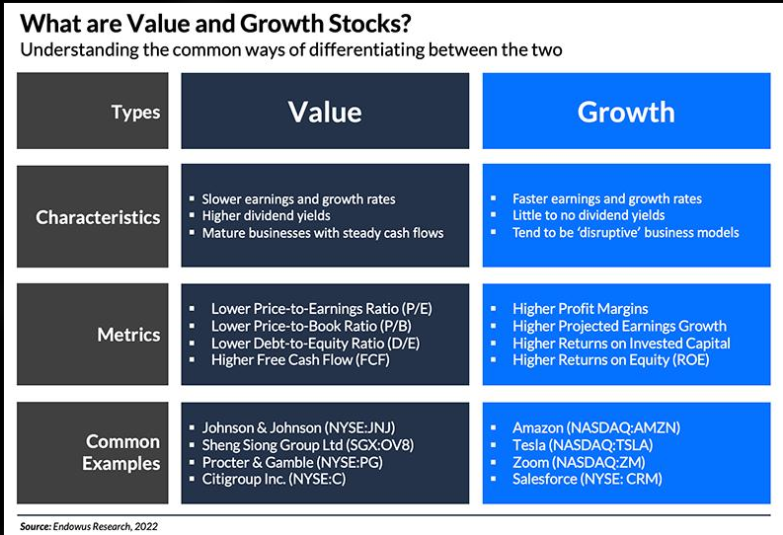
The following table summarizes the main differences.
| Feature | Growth Investing | Value Investing |
|---|---|---|
| Main objective | Invest in businesses expected to grow rapidly | Find stocks trading below estimated intrinsic value |
| Primary focus | Future growth in sales and earnings | Price relative to business fundamentals |
| Valuation | Often higher relative to current earnings | Often lower relative to earnings or assets |
| Company profile | May include newer or rapidly expanding businesses | Often includes established or temporarily unpopular businesses |
| Dividends | May be low or absent | May be available, but are not guaranteed |
| Main return source | Often capital appreciation | Potential price appreciation and sometimes dividends |
| Major risk | Growth fails to meet expectations | The company is cheap for a valid reason |
| Typical challenge | Determining a reasonable price for future growth | Determining whether a stock is genuinely undervalued |
These are general tendencies, not strict rules. There are profitable growth companies with low valuations and value companies with strong growth prospects.
Growth Investing vs. Value Investing: An Example
Consider two fictional companies: FutureTech Ltd. and Reliable Industries Ltd.
FutureTech is a technology business expanding rapidly. Its revenue is increasing, and it is investing heavily in new products. However, its shares trade at a relatively high price compared with current earnings.
Reliable Industries is an established manufacturer with stable customers and consistent cash flow. Its shares trade at a relatively low valuation because investors are concerned about slower growth.
A growth investor may prefer FutureTech because of its expansion opportunities.
A value investor may prefer Reliable Industries because its current market price appears low compared with the business’s underlying financial performance.
Neither choice is automatically better.
FutureTech could become much more profitable, rewarding investors who bought at a reasonable price. Alternatively, its growth could disappoint, causing its valuation to fall.
Reliable Industries could recover from temporary difficulties, allowing investors to benefit from a price increase and potentially dividends. Alternatively, its market share could decline, making its shares less valuable than expected.
The outcome depends on business performance, the purchase price, and the accuracy of the investor’s analysis.
Important Financial Metrics for Growth Investors
Growth investors commonly use several financial indicators to evaluate a company’s expansion potential.
Revenue growth rate
Revenue growth shows how quickly a company’s sales are increasing.
For example, if annual revenue rises from $50 million to $60 million, the growth rate is 20%.
However, investors should examine whether the growth is sustainable and whether it is translating into improved profitability.
Earnings per share
Earnings per share, or EPS, measures a company’s profit allocated to each outstanding ordinary share.
Increasing EPS can indicate improving profitability, although investors should investigate whether the increase comes from stronger operations, share repurchases, or temporary factors.
Price-to-earnings ratio
The P/E ratio compares a company’s share price with its earnings per share.
Growth investors may accept a higher P/E ratio when they believe future earnings will increase substantially. However, a high valuation leaves less room for disappointment if the company fails to meet expectations.
Free cash flow
Free cash flow indicates how much cash remains after operating expenses and capital expenditures.
A growing business that eventually generates strong free cash flow may have more flexibility to finance expansion and create shareholder value.
Return on invested capital
Return on invested capital helps investors assess how efficiently a company uses its capital to generate operating profits.
A business that can reinvest capital at attractive returns may have better opportunities to compound its value over time.
No single metric can determine whether a growth stock is a good investment. Investors should consider the company’s overall financial position, competitive advantages, and valuation.
Important Financial Metrics for Value Investors
Value investors often focus on valuation and financial strength.
Price-to-earnings ratio
A lower P/E ratio can indicate that a stock is inexpensive relative to its earnings. However, investors should compare the ratio with industry peers, historical levels, growth prospects, and business risks.
Price-to-book ratio
The price-to-book ratio compares a company’s market value with its reported net assets.
It can be useful in some asset-intensive businesses and financial institutions, but it is less informative for certain companies whose most important assets are intangible, such as software, brands, or intellectual property.
Price-to-free-cash-flow ratio
This ratio compares a company’s market value with the cash it generates after capital expenditures.
It can help investors evaluate how much they are paying for the company’s cash-generating ability.
Dividend yield
Dividend yield measures annual dividends per share relative to the current share price.
A high yield may be attractive, but it can also signal that investors expect a dividend cut or believe the business faces serious difficulties.
Debt-to-equity ratio
This ratio compares a company’s debt with its shareholders’ equity. It can help investors assess financial leverage, although appropriate debt levels vary by industry.
Value investors should use these metrics together rather than selecting stocks solely because they have low P/E ratios or high dividend yields.
Can You Combine Growth Investing and Value Investing?
Yes. Investors do not necessarily have to choose only one strategy.
A combined approach may involve selecting companies with promising growth opportunities while also insisting on reasonable valuations.
For example, an investor may look for a business that is increasing revenue, generating positive cash flow, and maintaining a strong competitive position, but whose shares are not priced as if exceptionally high growth is guaranteed.
This approach recognizes that business quality, growth, and price all matter.
Some investors also divide their portfolios between growth-oriented investments and value-oriented investments. Others use diversified funds that hold companies with different characteristics.
Combining strategies does not eliminate risk. Growth and value stocks can both decline, and both approaches can underperform the broader market for extended periods.
The most appropriate strategy depends on your investment objectives, risk tolerance, time horizon, and ability to evaluate companies.
Which Strategy Is Better for Beginners?
Neither growth investing nor value investing is universally better for beginners.
The right choice depends on what you understand, what you are trying to achieve, and how much investment risk you can comfortably accept.
Growth investing may appeal to investors who want exposure to companies with expanding markets, innovative products, and rising earnings. However, these stocks can be expensive and volatile.
Value investing may appeal to investors who prefer examining financial fundamentals and searching for businesses whose prices appear lower than their underlying worth. However, undervalued stocks may take a long time to recover, and some never do.
Beginners should consider the following principles:
- Learn how to read basic financial statements.
- Understand the risks associated with individual companies.
- Avoid purchasing stocks solely because they are popular or inexpensive.
- Compare valuations with realistic business expectations.
- Diversify rather than placing all your money in one company.
- Invest only money that fits your financial circumstances and time horizon.
- Consider broad-market index funds if researching individual companies is too difficult or time-consuming.
A diversified index fund can provide exposure to many companies without requiring you to decide which individual stocks will outperform. It is still subject to market risk and may lose value.
Common Mistakes to Avoid
1. Buying growth stocks at any price
A company can have excellent prospects but still be a poor investment if its share price already reflects unrealistic expectations.
2. Assuming every cheap stock is undervalued
Low valuations can reflect declining earnings, excessive debt, poor management, or a business model that is becoming obsolete.
3. Ignoring financial statements
Investors should investigate revenue, earnings, cash flow, debt, and other relevant indicators rather than relying only on stock-market commentary.
4. Expecting quick profits
Both growth and value investing require patience. Short-term price movements may not reflect the long-term performance of a business.
5. Failing to diversify
Even thorough research cannot eliminate the possibility of making a mistake. Diversification can reduce the effect of poor performance by any single holding.
6. Ignoring the purchase price
A company’s quality and its stock’s valuation are different questions. Investors should consider both before investing.
Conclusion
Growth investing and value investing are two important approaches to building wealth through the stock market.
Growth investing focuses on companies expected to increase their revenue, earnings, and business value faster than average. Value investing focuses on companies whose shares appear to trade below their estimated intrinsic value.
Growth investors often look for expansion opportunities, innovation, and future earnings potential. Value investors often emphasize valuation, financial strength, and a margin of safety.
Both approaches can succeed, and both can fail. Growth stocks can disappoint when expectations are too high, while value stocks can remain inexpensive because their businesses are deteriorating.
The most important lesson is that successful investing requires more than choosing a label. Investors must understand the business, evaluate its financial health, consider future prospects, assess risks, and pay a reasonable price.
For beginners, learning the principles behind both strategies can provide a stronger foundation for making informed investment decisions. Over time, investors can determine which approach fits their goals, or combine elements of both while maintaining a diversified portfolio.
Frequently Asked Questions (FAQs)
1. What is the main difference between growth investing and value investing?
Growth investing focuses on companies expected to expand rapidly, while value investing focuses on stocks that appear to be priced below their underlying business value.
2. Is growth investing riskier than value investing?
Growth investing can involve higher valuation risk and greater sensitivity to changing expectations. Value investing carries risks such as declining businesses and value traps. Neither strategy is always riskier; the actual risk depends on the investments selected and the prices paid.
3. Do growth stocks pay dividends?
Some growth stocks pay dividends, but many reinvest their earnings into expansion, product development, and other business opportunities.
4. Do value stocks always have low P/E ratios?
No. Low P/E ratios are common in some value strategies, but investors must consider cash flow, assets, debt, business quality, future prospects, and other valuation measures.
5. Can a stock be both a growth stock and a value stock?
Yes. A company can have strong growth prospects while trading below a reasonable estimate of its intrinsic value. Such opportunities can be attractive, but the investor’s valuation assumptions may still be wrong.
6. Which investing strategy is best for long-term wealth creation?
Neither strategy guarantees better returns. Long-term results depend on business performance, valuation, diversification, costs, and investor behavior. A diversified approach may be suitable for people who do not want to select individual stocks.
7. Can I start growth or value investing with little money?
Yes. Some brokers offer fractional shares, and some funds have relatively low minimum investment requirements. You should compare fees, platform eligibility, taxes, and investment risks before getting started.
8. Should beginners choose growth stocks or value stocks?
Beginners should first learn how to evaluate investments and understand risk. Broad-market index funds may be worth considering as a diversified alternative to selecting individual growth or value stocks.
Financial Disclaimer: This article is for educational and informational purposes only and does not constitute personalized financial or investment advice. Stocks can lose value, and no investing strategy guarantees profits. Conduct your own research and consider consulting a qualified financial adviser before making investment decisions.